
Create Printer
An AI powered printer to capture children’s imagination
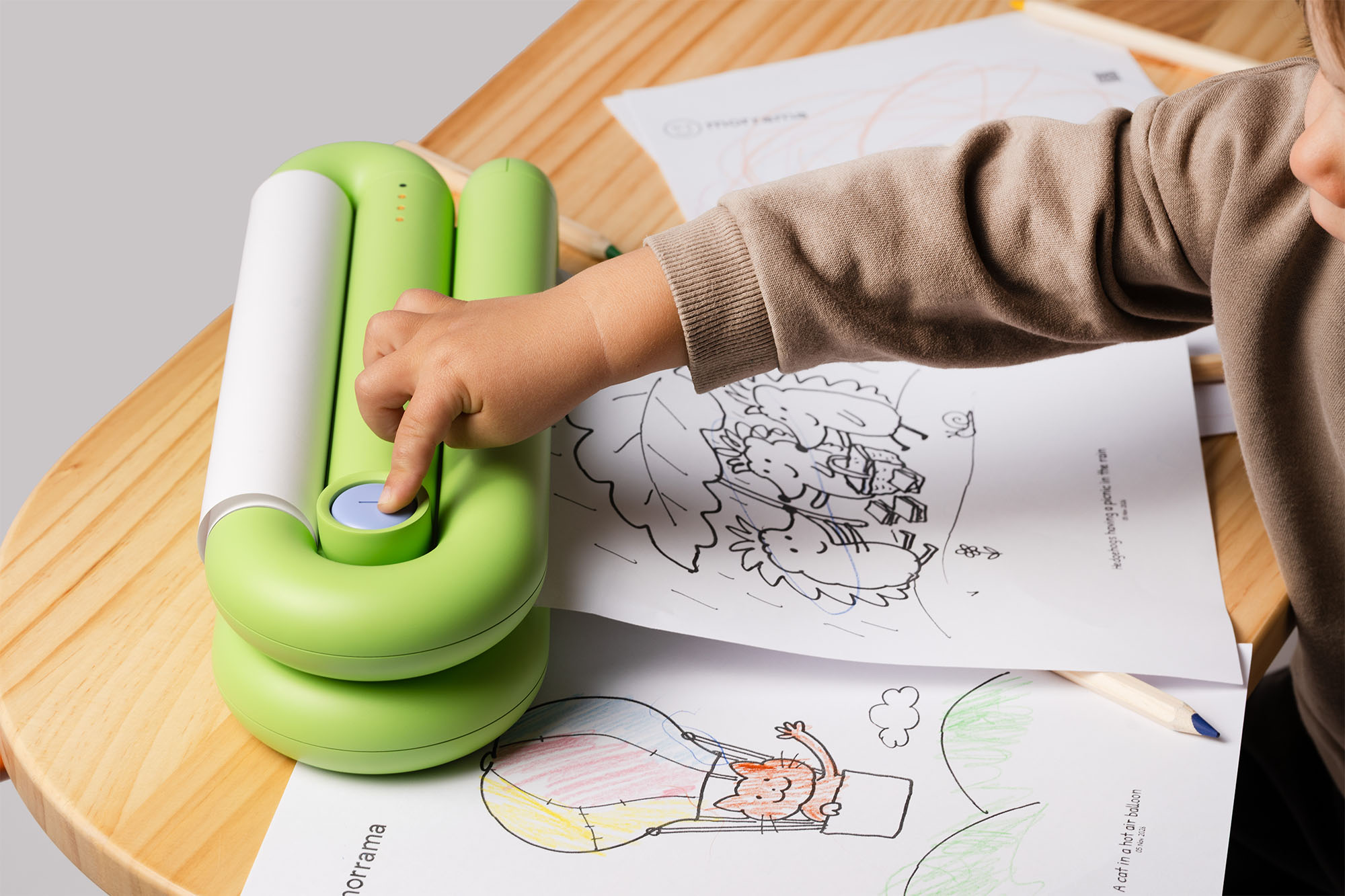
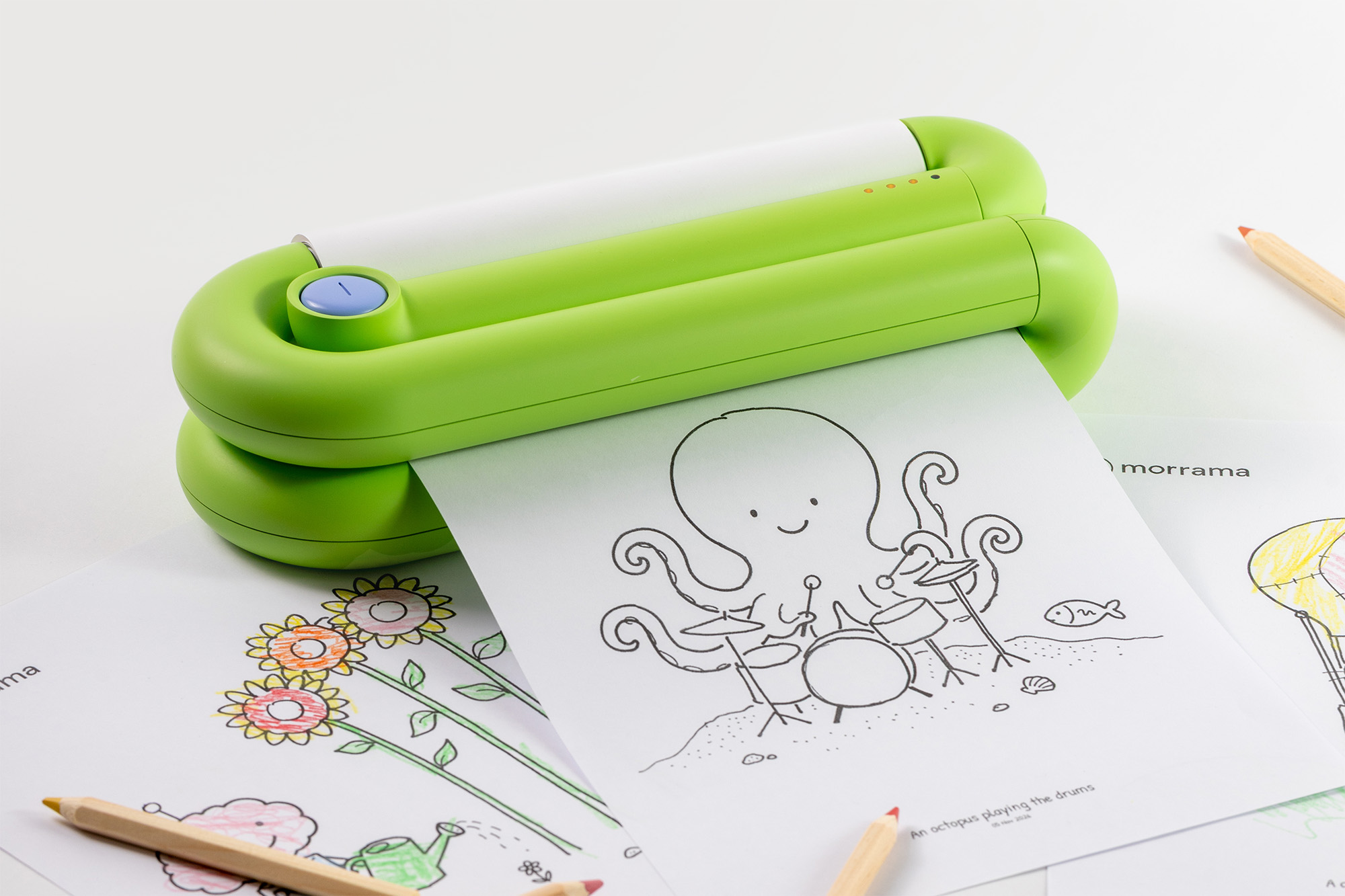
Using AI to empower kids creativity, the Create printer takes a child's prompt and turns this into a colouring drawing. An internal project designed as a platform for exploration into emerging technologies and compliance requirements in kids tech.
"The best way to predict the future is to create it." The line, usually attributed to Peter Drucker, has always resonated with me, but comes with a certain level of responsibility to consider those set to inherit it.
- Ben Melvin, Associate Director, Morrama.
In 2024 we developed the concept of Mindful AI Tools for Kids, an ecosystem of subtly intelligent products that help children be creative, find comfort and connect with family members. One of the products, named Create, turns a child's spoken idea into a printed picture. This playfully creative tool gives children a safe, hands-on, first experience of AI.
Case Study
The developments in AI have provided the technology both to power the printer and to build it. When we first considered the idea of these AI tools for kids in 2023 they were as future concepts, the technology having not quite yet arrived. Revisiting the project almost three years on however, and it’s not just a case of being able to build them, but the speed in which that becomes possible is game-changing.
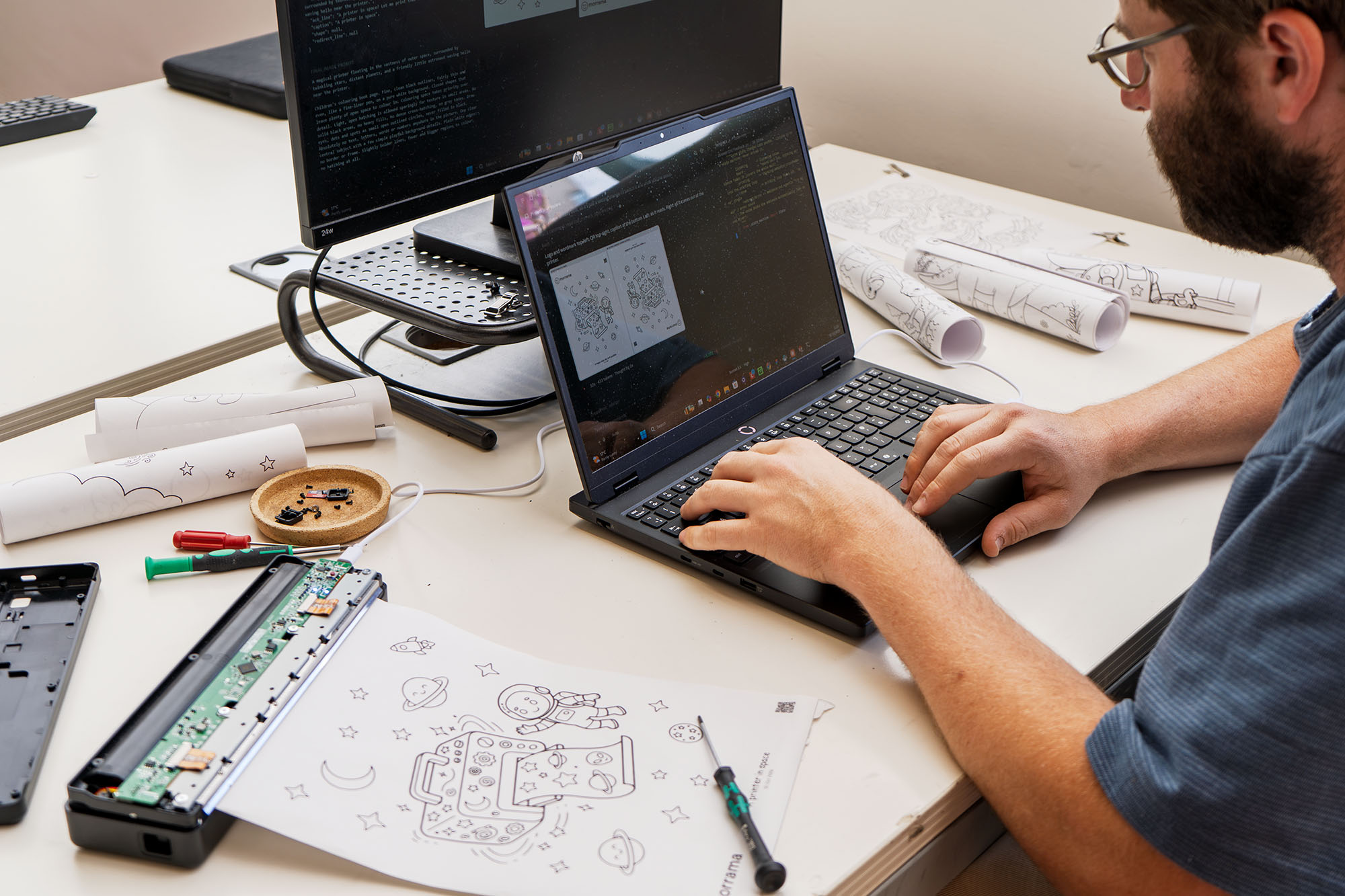
Since V1, the prototype has moved from a laptop to a phone-based app that talks to the printer over Bluetooth. Behind that simple loop, a few things happen in sequence. When a child presses the button, Create listens only for as long as it’s held. The recording goes to Gemini, which listens to the audio itself (no separate transcription) and interprets it generously: invented words, half sentences and muddled grammar are all expected. It pulls out the core idea and writes a short, consistent drawing brief, along with a friendly spoken reply, so the child hears their idea played back while they wait. A final check makes sure no stray letters or numbers have crept into the picture, then the image is converted to crisp black and white and sent over Bluetooth to the printer.
Multiple versions of this pipeline have been built and tested, each varying in refinement, safeguarding and output fidelity. From spoken idea to paper takes under a minute and costs a few pence per page, with the fastest version starting to print in around 15 seconds.
Housing the electronics in the enclosure we’d designed was fairly straightforward. The more interesting work lay in the refinements. We tuned the device to the pace at which children think and speak, e.g. giving them time to pause mid-sentence without being cut off, and refined the prompt logic so every print stayed true to Create’s visual style.
It works, but what does it do?
With something to test, it was on to stress-testing.
AI is polarising, and AI for children is particularly divisive. We've all seen the harm technology can do to young minds, from screen addiction to social media. Children are impressionable, and as designers we have a responsibility to think not only about the experience we want to create, but also the unintended consequences of a product. What does a product do to the person using it? Does it do good, or could small wins grow into habits we come to regret? With Create we wanted to foster a child’s imagination and encourage the contribution to the creative output by leaving them pictures to colour in. But it quickly became clear that colouring was nowhere near as fun as pressing the button, speaking to the printer and being rewarded with a picture.
Who’s work are we pulling from?
The printer's role is to combine spoken ideas into a visual image. The AI can only do that because it’s been fed a lot of imagery - many of which is other people’s work. Encouraging creativity in one person by using a model trained without permission on that of another is something we do without thinking all the time. After all, it’s what many of us are using AI tools for in our own work. But we felt uncomfortable with the idea of Create existing as a business on that premise, so we began exploring how we could train it only on specifically selected imagery to create a ‘house style’. That style evolved over testing: rather than a polished colouring-book look, Create now draws as if a five-year-old had picked up a thick black marker, with wobbly lines, big heads and simple closed shapes ready to colour. Each request includes reference line drawings, plus a small randomly chosen “mood” (a child drawing fast, a child going over circles twice), so no two pages feel the same. We could in theory train the model on anything, and if we were to launch Create as a commercial product, we’d imagine collaborations with artists that see licensing fees flow back to them.
Safety first
Create is still a prototype built with a model not designed for children, not a product children use unsupervised, but its safety design is where most of our thinking has gone. COPPA compliance in the US is the strictest of the major children's privacy frameworks. It requires verifiable parental consent before personal information is collected from a child under 13, and a recording of a child's voice counts as personal information. That is exactly what Create captures each time the button is pressed, so the product has to be designed around that from the start.
The principle is layering: no single filter is trusted. In our most developed version, a request passes the AI model’s own safety filters, our own word lists, a second model that reviews everything before anything is drawn, and a check of the finished picture. If any check fails, or anything errors, nothing prints, and the child hears a gentle redirect to try another idea.
Some moments need more care than a refusal. If a child mentions something worrying, such as being hurt or copying something dangerous, Create won’t draw it, and instead gently encourages them to talk to a grown-up they trust. Equally, being over-cautious has its own cost: a birthday cake with candles or two blue tits on a bird feeder shouldn’t be turned away. So we tested innocent “near-miss” ideas as rigorously as risky ones. For our story-telling mode, we built a set of over 300 test stories designed to trip the system up, and are adding stories written by people who haven’t seen the rules, as an honest test.
A version for real children would go further: listening only while the button is held, no children’s accounts, no recordings kept anywhere, including by the AI services themselves, which would be used under zero-data-retention terms that also keep children’s data out of training, simple parent controls, design in line with the UK’s Children’s Code, and independent review by child-safety specialists before it reaches a single child.
In the ideal world, the AI inference would be happening on-device and nothing would touch the cloud. However the hardware requirements would make the device cost prohibitive and so with the clever part happening in the cloud, a third party developer tool such as AstroSafe’s API would be required to provide the necessary gateway to keep both the child’s sensitive data secure and the content they get in response to a prompt guaranteed child-friendly.
Where next?
We have been exploring solutions to all the above questions and iterating the prototype to build out a more robust offering. It’s now become a really exciting interactive device with much deeper educational potential and we are now seeking investment to take it to the next level.
You can register your interest at create@morrama.com

